

The quote comes in at a number that looks fine. Thirty thousand a year, a clean line on a purchase request, approved before the plant manager has finished reading it. Eighteen months later the same platform is running on a few dozen licensed boxes, the security lead wants every machine segmented instead of every cell, the network team has bought an overlay mesh, and somebody is paying a cloud bill for the management servers. Nobody lied. The first quote priced a deployment the plant was never going to keep.
Edge platform quotes are hard to compare because vendors bill different units and ship different defaults. ZEDEDA licenses nodes. Litmus publishes site-based plans, and this paper models it per node. EmberNet bills control planes, and never counts or bills the machines behind them. A comparison that lines up the license lines flatters whichever vendor leaves the most off the invoice, so this paper prices one outcome on every column: the outcome EmberNet ships by default.
- Redundancy at every plant: three servers, so the plant survives the loss of any one.
- A zero-trust mesh that reaches every machine.
- The compute the management layer needs to run, with its own redundancy.
- An enforcement point at every machine.
Both competitors’ base deployment is one server per site, with no redundancy. Redundancy, the mesh, and the management compute are things the buyer adds and pays for. This paper prices them at three licensed servers per site, with the mesh and management compute added, so the comparison is like for like.
The paper is written by the company that sells one of the three products, so it shows its working. Every competitor input is labeled by where it comes from: published by the vendor, from Fireball’s pricing study, or a Fireball model built from published rates. A model value estimates a shape. It is not the competitor’s price. Enterprise quotes are negotiated and usually discounted, so if you hold a real quote, price against it and use this paper for the method.
Prices as published or modeled on 30 September 2026. Every published price was rechecked at its source on 6 October 2026.
A self-check before you compare anything
Try to answer these about the deployment you are actually buying, not the pilot.
- How many machines will eventually sit behind the platform, and how many of them need their own enforcement point rather than sharing one at the cell boundary?
- How many servers does each quote put at each plant, and what happens to that plant when one of them dies?
- Where does the management layer run, who hosts it, and is its compute on the quote or on somebody else’s invoice?
- Which zero-trust network does each quote assume, and who pays for it per device?
- How many people build container images for the plant, and does your company size trigger a paid Docker Desktop license?
- What does each quote cost when you add 100 machines at a plant you already run, and what does it cost when you add a sixth plant?
- Which numbers on each quote are list prices, and which are the first offer in a negotiation?
If two or more of those are blank, the quotes you hold are not yet comparable.
What a secured deployment actually pays for
Every secured edge deployment pays for four things. Vendors differ in which of them they bill, which they include, and which they leave for the buyer to discover.
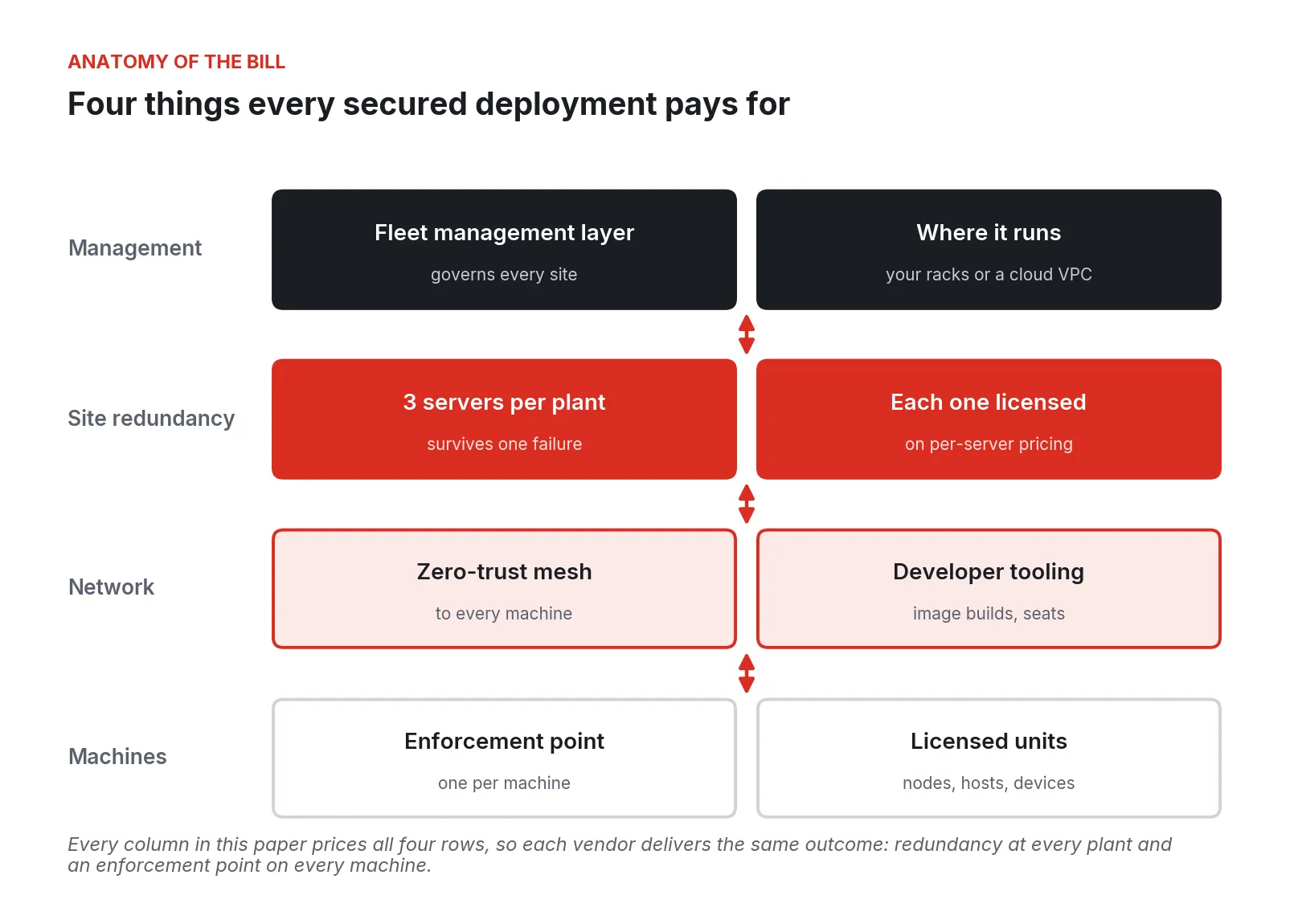
Figure 1. The four rows of an edge platform bill. Every comparison in this paper prices all four rows on every column.
| Line | What it is | How this paper prices it |
|---|---|---|
| Management layer | The control plane that governs every site | Competitors: a redundant trio of cloud servers at partner VPC rates. EmberNet: on customer hardware, cloud optional |
| Site redundancy | Servers at each plant | Three per plant on every column, each licensed where the vendor licenses servers |
| Zero-trust network | The overlay that lets devices reach each other by identity | Competitors: ZeroTier at published rates. EmberNet: included |
| Developer tooling | Seats for whoever builds container images | Competitors: five Docker Business seats. EmberNet: EmberForge |
| Enforcement points | Where policy is applied | One per machine on every column |
Redundancy: why three per plant
A control plane is a member of a quorum. With one member, losing the box loses the plant’s control plane, and every machine behind it. With three, two remain, they still form a majority, and the plant keeps running while the third is replaced. Five members survive two failures and suit a dense plant. Even counts add a member without adding tolerance.
ZEDEDA’s documentation describes the same shape well: three equal nodes that give “a proper quorum for cluster decisions,” with automatic application failover when one goes down [3]. It is available to ZEDEDA customers who build it. On a platform that licenses every node, it means three licensed nodes per site before a single machine is connected, and that is how this paper prices it.
A single-server deployment has its place: proving a platform on one line. It is a single point of failure, and pricing a production plant that way makes a quote look smaller than the plant it describes.
Enforcement points: one per machine
The second row is where the security posture and the price meet. A plant can put policy at the cell boundary and leave the machines behind it on a shared segment, or it can put an enforcement point at every machine, so a compromised HMI cannot reach the next cell’s controller. NIST’s guide to OT security treats segmentation and boundary protection as core countermeasures for exactly this reason [10]. On a platform that licenses every node it manages, an enforcement point per machine means a licensed node per machine. On a platform that never counts machines, the bill does not move.
ZEDEDA may answer per-machine policy in other ways; EVE-OS has network policy of its own, and one EVE-OS node can run many workloads without consuming more licensed nodes [1]. Pricing a licensed node per machine is our model of what per-machine enforcement costs on a per-node license. It is a reasonable reading of the published unit, not something ZEDEDA has said.
Where every input comes from
| Input | Value | Status | Source |
|---|---|---|---|
| ZEDEDA Starter Kit | $30,000/yr, up to 30 nodes | Published | AWS Marketplace |
| ZEDEDA above 30 nodes | $1,000/node x volume factor | Model | Fireball extrapolation |
| Litmus per node | $1,500/node/yr | Model | Fireball pricing study, low end |
| Servers per plant | 3, licensed | Model | Redundancy parity |
| ZeroTier mesh | $18 or $179/mo plus per device | Published | zerotier.com |
| Cloud management trio | $287.60/server/mo | Partner rate | Partner VPC rates |
| Docker Business | $24/user/mo, 5 seats | Published | docker.com |
| EmberNet levels | Pilot free (evaluation and pre-production); Starter $2,500/mo; Pro $5,000/mo; Enterprise: contact sales | Published | embernet.ai |
Table 1. Provenance of every input in this paper. Published figures were opened at the source on 30 September 2026 and rechecked on 6 October 2026; pricing-study and model figures are Fireball Industries inputs, stated so they can be replaced with your own.
ZEDEDA
Published: the ZEDEDA Starter Kit on AWS Marketplace is a 12-month subscription at $30,000, covering up to 30 nodes of any type with standard support [1]. A node is one edge device running EVE-OS, and one node can run containers, VMs, and Kubernetes side by side [1]. ZEDEDA publishes three-node HA clusters with automatic failover [3], and Edge Sync, which carries signed, encrypted configuration from ZEDEDA Cloud into a disconnected site and keeps the cloud as the single source of truth when connectivity returns [4]. Both are real engineering, and both are credited here.
Not published: anything above 30 nodes. The listing directs buyers to the vendor beyond that [1]. ZEDEDA sells larger deployments; their pricing for them is not public.
Model [2]: above 30 nodes we extrapolate the kit’s full-utilization rate of $1,000 per node per year, then apply an assumed volume discount (0.85 from 100 units, 0.70 from 500, 0.60 from 1,000, 0.50 from 2,500, 0.45 from 5,000). Licensed units are the machines plus three servers per plant. If your ZEDEDA quote differs, it is the number that counts.
Unconfirmed: whether ZEDEDA’s subscription includes a zero-trust overlay mesh to every machine. We found none in the listing, and no statement that it is absent. The ZEDEDA column carries a ZeroTier line; if your deployment does not need it, subtract it.
Litmus
Published: Litmus’s pricing page lists a Foundation plan starting at $1,500 a month, with Growth and Scale quoted by sales, and describes its plans as site-based pricing [6]. The page lists no per-node price.
Model [2]: this paper models Litmus per node, at $1,500 to $5,000 per node per year. The range comes from Fireball’s pricing study; one third-party estimate puts Litmus Edge at $2,000 to $5,000 per edge node per year [16]. This paper uses the low end, $1,500, for every Litmus figure. Licensed units are the machines plus three servers per plant, with the same volume discount as above. It is our model, not Litmus’s price; if your Litmus quote differs, it is the number that counts. At the high end of the range, the five-plant, 500-machine figure below rises from $563,656 to about $1.8 million.
Credit where it is due: Foundation includes 250-plus protocol drivers, edge storage, and a native message broker [6], and Litmus Edge Manager’s remote access opens on a ZeroTier network tab by default [7], so the overlay client is built in. The ZeroTier client is open source; the commercial network service is licensed per device beyond ten devices [8], so the Litmus column carries the ZeroTier line.
Lines added to both competitor columns
ZeroTier mesh, published: Essential at $18 a month with 10 devices then $2 each; Scale at $179 a month with 100 devices then $1.80 each [8]. We price the cheaper plan for each device count. Tailscale is the other common choice: $8 or $18 per user per month, with a per-device charge of $1 a month for unattended machines beyond the first 50 [9].
Management compute, partner rates: a redundant trio of management servers in a VPC through Fireball’s cloud partner, at $287.60 per server per month, or $10,354 a year for the trio [2]. ZEDEDA hosts its controller as SaaS inside the subscription [1]; we add the trio at the same rates on both competitor columns so the management layer is priced the same way everywhere.
Docker Business, published: $24 per user per month [11]. Docker Desktop requires a paid subscription at companies with 250 or more employees or $10 million or more in annual revenue [12]. We add five seats, $1,440 a year, to each competitor column.
EmberNet
Published on embernet.ai and in Fireball’s pricing plan [13][14]: Pilot is free, one per organization, and is for evaluation, development, training, and pre-production; a production plant runs on Starter or above. Starter is $2,500 a month, sized for about nine control planes (two plants plus a parent trio). Pro is $5,000 a month, sized for about eighteen (five plants plus a parent trio). Additional control planes are $320 a month each on Starter and Pro. For Enterprise, contact sales. Pricing is per organization, users are not seat-priced, and every level includes zero-trust networking, an MQTT broker, and factory SSO. Worker nodes are not license limited: they are never counted or billed.
In this paper every production plant starts on Starter. One or two plants run on Starter at $2,500 a month, and five plants on Pro at $5,000 a month. Larger estates stay on Pro and add control planes at $320 a month each, three per plant; Enterprise terms come from a conversation with sales. EmberNet runs on customer hardware. Cloud is optional; a customer who chooses to run the parent trio in a VPC through Fireball’s cloud partner pays that compute on top, at the partner’s rates. No Docker seats appear in the EmberNet column, because EmberForge is the build environment. EmberNet can be paid month to month, so Starter is $2,500 a month, not $30,000 up front. The tables annualize every column only so they can be compared line for line with annual competitor subscriptions.
The numbers
| Plants | Machines | EmberNet | ZEDEDA (model) | Litmus (model, low end) |
|---|---|---|---|---|
| 1 | 30 | $30,000 | $45,562 | $62,062 |
| 1 | 50 | $30,000 | $66,042 | $92,542 |
| 1 | 100 | $30,000 | $101,556 | $145,331 |
| 1 | 500 | $30,000 | $374,746 | $550,796 |
| 1 | 1,000 | $30,000 | $635,246 | $936,146 |
| 2 | 100 | $30,000 | $104,171 | $149,221 |
| 2 | 500 | $30,000 | $376,911 | $554,011 |
| 5 | 250 | $60,000 | $242,756 | $355,381 |
| 5 | 500 | $60,000 | $383,406 | $563,656 |
| 5 | 1,000 | $60,000 | $642,706 | $947,206 |
| 10 | 1,000 | $117,600 | $652,030 | $961,030 |
| 20 | 1,000 | $232,800 | $670,678 | $988,678 |
| 50 | 5,000 | $578,400 | $2,440,522 | $3,599,272 |
Annual cost, every column at the same outcome. Competitor columns include three licensed servers per plant, the ZeroTier mesh, the cloud management trio, and five Docker seats. EmberNet rows above five plants are Pro plus add-on control planes at $320 a month: three per plant and a parent trio, less the eighteen Pro includes.
Figure 2. Annual cost at one plant as the number of secured machines grows. EmberNet at its published Starter price; ZEDEDA and Litmus lines are Fireball model values built from the inputs in Table 1.
Read Figure 2 left to right. The EmberNet line stays flat at Starter, because machines are not a billing dimension. The competitor lines climb, because in the model every machine adds a licensed node and a mesh device. Instrumenting the whole floor at a plant you already run costs nothing more on EmberNet.
Figure 3. Cost per secured machine per year at five plants. Hatched bars are Fireball model values; divide your own quote by your own machine count to compare.
Figure 3 is the same data divided by machine count. A per-node license holds near its rate wherever you look. A control-plane license spreads across however many machines the plant puts behind it, so the cost per machine keeps falling as the plant grows.
Five plants, line by line
The most common serious shape we see is a regional manufacturer: five plants, around a hundred machines each. Table 2 breaks the totals into their lines so each one can be checked against a real quote.
| Line | EmberNet Pro | ZEDEDA (model) | Litmus (model) |
|---|---|---|---|
| Platform license | $60,000 | $360,500 | $540,750 |
| Zero-trust mesh | Included | $11,112 | $11,112 |
| Cloud management trio | Optional | $10,354 | $10,354 |
| Docker seats (5) | EmberForge | $1,440 | $1,440 |
| Annual total | $60,000 | $383,406 | $563,656 |
Table 2. A five-plant, 500-machine manufacturer, every column at three servers per plant, a mesh to every machine, and an enforcement point per machine. ZEDEDA and Litmus license lines are Fireball model values.
- Platform license. EmberNet Pro covers eighteen control planes: three at each plant and a parent trio. The competitor licenses cover 515 nodes: 500 machines and fifteen site servers.
- Zero-trust mesh. Included on EmberNet. About $11,100 a year on each competitor column at ZeroTier’s published rates, plus the engineering time to run another console and another set of credentials.
- Management compute. On EmberNet, the parent trio runs on customer hardware. On the competitor columns, a redundant cloud trio adds $10,354 a year.
- Developer tooling. EmberForge on EmberNet; five Docker seats on each competitor column.
The total is $60,000 a year on EmberNet, paid as $5,000 a month, against $383,406 on the ZEDEDA model and $563,656 on the Litmus model: 6.4 and 9.4 times the EmberNet figure.
What each price includes
| Line item | EmberNet | ZEDEDA | Litmus |
|---|---|---|---|
| Billing unit | Control planes | Nodes (30 in kit) | Site-based (published); per node (our model) |
| Default site shape | 3 control planes | 1 server, no redundancy | 1 server, no redundancy |
| Zero-trust mesh | Included | Unconfirmed | ZeroTier client; service per device |
| Management compute | Your hardware | Priced as cloud trio | Priced as cloud trio |
| Build tooling | EmberForge | Docker seats | Docker seats |
| Machines | Never counted or billed | Licensed | Licensed |
Table 3. What each price includes and how this paper prices it. “Unconfirmed” means we found no published statement either way.
Left out on every side: application licensing and implementation, which are equal across vendors, and capabilities only one vendor sells, which cannot be priced against nothing.
How to check this against your quote
Use this method on any quote, ours included. It takes an afternoon with a spreadsheet.
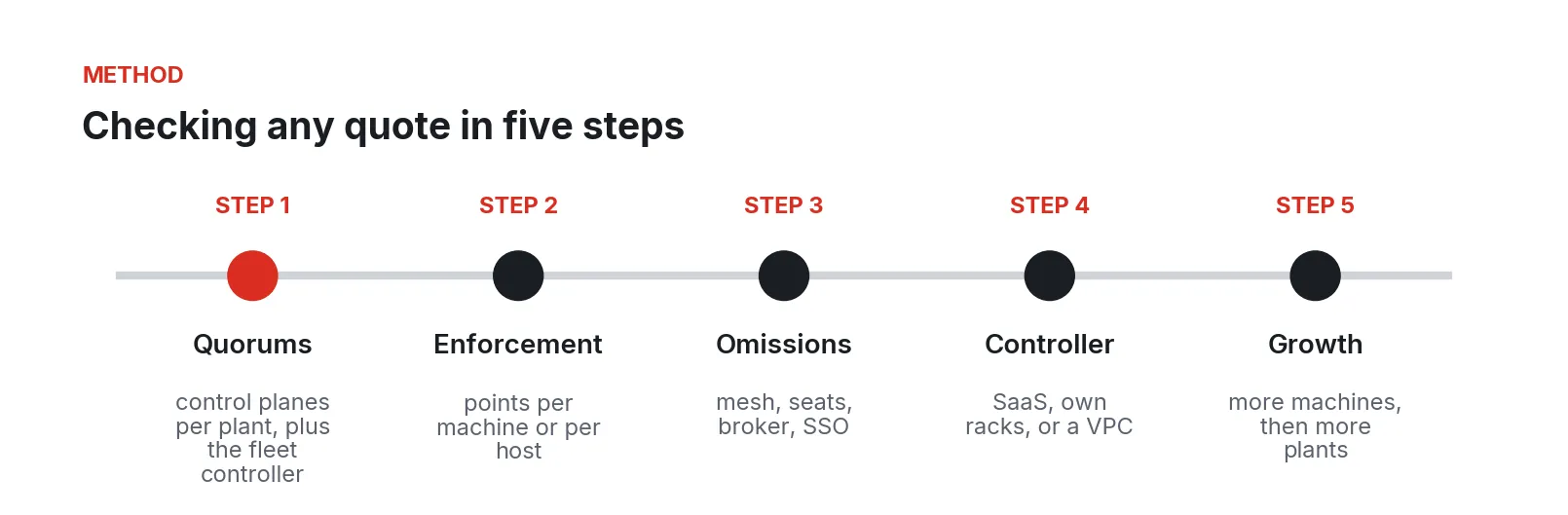
Figure 4. The five-step check. Run it on every quote you hold, including EmberNet’s.
- Count control planes. Write down how many servers each quote puts at each plant and where the management layer runs. If a quote has one server per plant, price two more at the vendor’s per-server rate. One per plant is a single point of failure, and that difference shows up during an outage rather than at signature.
- Count enforcement points. Decide where policy has to sit, then count the licensed units each vendor needs for an enforcement point at every machine. Ask ZEDEDA how many EVE-OS nodes your plant requires for that posture, and ask Litmus in writing what its site-based price comes to at your machine count.
- Add what each vendor leaves out.
- The zero-trust mesh, per device, at ZeroTier’s or Tailscale’s published rates, unless the vendor confirms in writing that it is included.
- Docker Desktop seats, if your company crosses 250 staff or $10 million in revenue.
- A message broker and factory SSO, where they are not in the subscription.
- Decide where the management layer runs. SaaS inside the vendor’s price, your own racks, or a cloud VPC. Put the compute on the same sheet as the license.
- Price growth both ways. Add 100 machines at a plant you already run, then add a plant. Price both on every quote. This is the step that separates a license that fits the pilot from one that fits the plant.
Then replace every model value in this paper with the numbers on your quote, and keep the same four rows on every column.
Where these comparisons go wrong
- Mixing defaults. A one-server site priced against a three-server site is not the same deployment. Price redundancy on every column, then compare.
- Quoting an extrapolation as a price. Every ZEDEDA figure above 30 nodes in this paper is ours, and so is the Litmus per-node model, built from Fireball’s pricing study. A real quote outranks both.
- Ignoring negotiation. List rates are the ceiling, and large deployments get discounts. That is why our model applies a volume discount, and why your quote is the number to use.
- Leaving the mesh off. It is small at 30 devices and about $11,000 a year at 500, plus the engineering time to run it.
- Forgetting management compute. A cloud-hosted management layer is real money: about $10,354 a year for a redundant trio at partner rates.
- Pricing the pilot. A single server on one line is small everywhere. The plant you will run in three years is the one to price.
- Counting hosts instead of machines. If policy has to sit at every machine, the licensed count is the machine count.
Security and compliance in the same terms
The outcome priced here maps onto the language your security program already uses. The ISA/IEC 62443 series sets requirements for asset owners, integrators, and product suppliers, and Part 3-2 covers security risk assessment for system design, where a plant decides how to partition its systems into zones and the conduits between them [15]. NIST SP 800-82 Rev. 3 gives U.S. federal guidance on securing OT, including segmentation and boundary protection [10].
Neither standard tells you to put an enforcement point at every machine. They tell you to decide your zones from a risk assessment and to protect the conduits. A per-node license puts a price on every zone boundary you draw, which pushes a plant toward fewer, larger zones. A license that never counts machines leaves the zone design to the risk assessment. Compliance itself stays with the site’s program; no platform, ours included, makes a plant compliant.
On isolated sites, ask every vendor the same question: can a configuration change be authored with no internet-connected machine anywhere in the loop, and how does a new container image get in? ZEDEDA documents its Edge Sync workflow openly [4]; check our answer with the same rigor.
A phased way to buy
- Prove it on one line. Run the free Pilot or a competitor’s trial on a single line for a month.
- Price the plant you intend to run. Use the five-step check at full machine count, with redundancy and an enforcement point at every machine on every column.
- Stand up the first plant with three control planes on your own hardware. On EmberNet a production plant runs on Starter or above.
- Add plants. A second plant stays on EmberNet Starter, and five plants move to Pro; beyond that, each plant is three more control planes at $320 a month each. For Enterprise terms, contact sales. On per-node platforms, price the nodes the new plant brings.
What to do Monday
Pull every edge platform quote you hold. For each, write down four numbers: servers per plant, licensed units at full machine count, the mesh and seat costs the quote leaves out, and where the management layer runs. Then price one more plant and one more hundred machines on each. The quote that still makes sense after that is the one that fits the plant.
Fireball Industries is EmberNet’s master integrator. We design, build, and support EmberNet deployments, and we will run the five-step check with you against any quote you hold, ours included.
Sources
- ZEDEDA, Inc. via Amazon Web Services, “ZEDEDA Starter Kit,” AWS Marketplace listing, accessed 6 October 2026. https://aws.amazon.com/marketplace/pp/prodview-3mimdpwtojovk
- Fireball Industries, EmberNet pricing model and scenario generator (internal), September 2026. Source of all EmberNet figures, the Litmus pricing study ($1,500 to $5,000 per node per year, low end used), and the model method: three licensed servers per plant, $1,000 per ZEDEDA node above 30, volume discounts 0.85/0.70/0.60/0.50/0.45 at 100/500/1,000/2,500/5,000 units, management trio at $287.60 per server per month at partner VPC rates.
- ZEDEDA, “Edge Node Cluster Overview,” ZEDEDA Help Center, 4 February 2026. https://help.zededa.com/hc/en-us/articles/33103243486747-Edge-Node-Cluster-Overview
- ZEDEDA, “Edge Sync,” product page, accessed 30 September 2026. https://zededa.com/products/edge-sync/
- Fireball Industries, EmberNet Pricing Model, live calculator (internal), September 2026. Inputs for the EmberNet level ladder and partner VPC rates.
- Litmus Automation, “Litmus Pricing,” accessed 6 October 2026. https://litmus.io/pricing
- Litmus Automation, “Edge Remote Network,” Litmus Edge Manager documentation, updated 19 December 2024. https://docs.litmus.io/edgemanager/lem-user-ui/product-features/remote-access/edge-remote-network
- ZeroTier, Inc., “ZeroTier Pricing,” accessed 6 October 2026. https://www.zerotier.com/pricing/
- Tailscale Inc., “Pricing,” accessed 6 October 2026. https://tailscale.com/pricing
- K. Stouffer et al., NIST, “SP 800-82 Rev. 3, Guide to Operational Technology (OT) Security,” September 2023. https://csrc.nist.gov/pubs/sp/800/82/r3/final
- Docker, Inc., “Pricing,” accessed 6 October 2026. https://www.docker.com/pricing/
- Docker, Inc., “Docker Desktop license agreement,” Docker Docs, accessed 6 October 2026. https://docs.docker.com/subscription-billing/desktop-license/
- Fireball Industries, “EmberNet Pricing,” embernet.ai, accessed 6 October 2026. https://embernet.ai/pricing.html
- Fireball Industries, EmberNet Pricing and Licensing Plan (internal), September 2026.
- International Society of Automation, “ISA/IEC 62443 Series of Standards,” accessed 30 September 2026. https://www.isa.org/standards-and-publications/isa-standards/isa-iec-62443-series-of-standards
- MachineCDN (third-party estimate; a competing vendor’s blog), “Litmus Pricing in 2026: What Does Litmus Edge Really Cost?,” 7 January 2026. https://www.machinecdn.com/blog/litmus-pricing/